Doing science experiments at home with your student allows them to learn through direct experience. It encourages curiosity and helps them understand how the world works in a practical and memorable way.
Building STEM skills from an early age is important, as science, technology, engineering and maths help children develop problem solving, creativity, and critical thinking that are essential for academic success. When children explore scientific ideas in a hands-on setting, they gain confidence as they ask questions, test ideas, and discover results.
These simple home experiments are a fun way to strengthen those skills while making learning engaging and meaningful.
Colour Changing Milk Experiment
Materials needed: milk, shallow dish, food colouring, dish soap, cotton bud
This experiment allows children to observe how different substances interact in a fluid environment. When drops of food colouring are added to milk, they remain separate at first, creating visible patterns. When dish soap is introduced, it interacts with the fat in the milk and causes the colours to move rapidly in swirling shapes. The movement helps children see how substances can react differently depending on their properties and encourages careful observation of change over time. It aids in:
• Understanding chemical interaction
• Observing movement in liquids
• Developing curiosity about material properties
Balloon Inflation with Yeast and Sugar
Materials needed: yeast, sugar, warm water, plastic bottle, balloon
This activity shows children how living organisms can produce gas through natural processes. When yeast is combined with warm water and sugar, it begins to consume the sugar and release carbon dioxide. The gas gradually inflates a balloon placed over the bottle opening. Children can observe how biological reactions can create visible physical changes and how temperature and ingredients affect the speed of the process. It aids in:
• Understanding fermentation
• Observing gas production
• Learning about living organisms
Walking Rainbow Paper Towels
Materials needed: paper towels, water, food colouring, multiple clear cups
Children explore how liquid can travel through absorbent materials by connecting cups of coloured water with paper towel strips. Over time, the liquid moves along the towels and mixes in the empty cups, creating new colours. The slow movement helps children observe how water can travel against gravity through small spaces. It also encourages prediction and comparison of colour changes as the process unfolds. It aids in:
• Understanding capillary action
• Observing colour mixing
• Developing prediction skills
Seed Germination in a Clear Container
Materials needed: clear plastic container or jar, paper towel, seeds, water
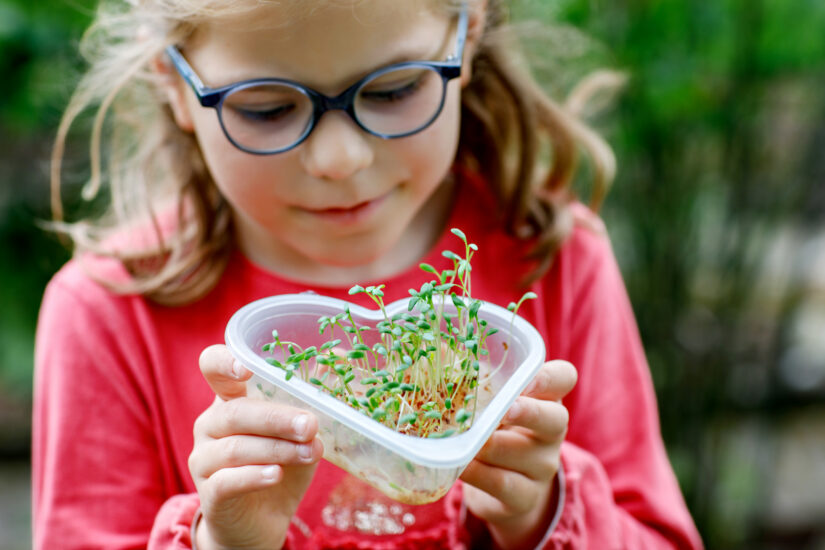
This experiment allows children to observe the early stages of plant growth in real time. Seeds are placed against a damp paper towel inside a clear container so changes can be seen as they occur. Over several days, children can watch roots and shoots develop and expand. It provides a clear view of how living organisms begin their life cycle and respond to moisture and light conditions. It aids in:
• Understanding plant growth
• Observing life cycles
• Learning about environmental needs
Water Surface Tension Experiment with Pepper
Materials needed: water, shallow dish, ground pepper, dish soap, cotton bud
Children sprinkle pepper onto the surface of still water and observe how it floats due to surface tension. When a drop of dish soap is introduced, the pepper quickly moves away from the point of contact. This happens because soap reduces surface tension, causing movement across the water’s surface. The experiment helps children see invisible forces at work and how liquids can behave in unexpected ways. It aids in:
• Understanding surface tension
• Observing invisible forces
• Developing scientific observation skills
How Tutor Doctor Builds STEM Skills
At Tutor Doctor, we believe STEM learning grows best when children are encouraged to explore, question, and make sense of what they observe. Home science experiments give students the chance to think like young scientists, building confidence through hands-on discovery.
Our tutors support this process by strengthening problem-solving, critical thinking, and understanding, helping students turn everyday curiosity into lasting STEM skills.
Contact us for a free consultation!