
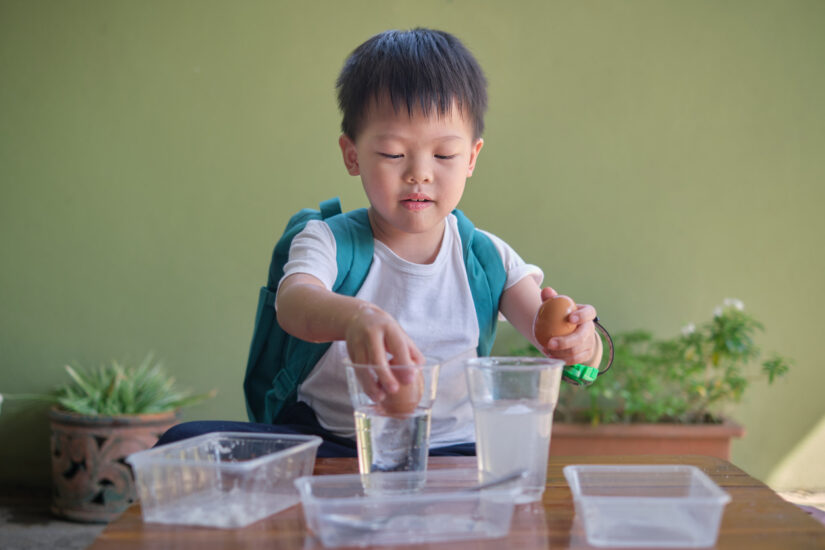
Hands-on experiments at home are a wonderful way for parents to introduce children to STEM and encourage a natural curiosity about the world around them. By conducting simple experiments, children can ask questions, make predictions, test their ideas, and observe the results firsthand. These activities help build important skills such as careful observation and problem solving, in a fun and engaging way.
The egg and toothpaste experiment is a great example. Using everyday household items, children can explore how acids react with calcium and gain an introduction to the basics of chemistry. It is a simple activity that builds a scientific mindset, and creates an opportunity for parents to discuss the science behind everyday experiences, including how toothpaste helps protect teeth.
How to Do the Egg and Toothpaste Experiment
This experiment explores how acid reacts with an eggshell and how a coating can reduce direct contact between the shell and the acid.
You’ll need:
- 2 hard-boiled eggs
- Toothpaste
- 2 clear glasses or jars
- White vinegar
- A spoon or butter knife
- Water for rinsing the eggs
Cover one egg completely with toothpaste, leaving the other untreated. Place each egg into a separate glass and pour in enough vinegar to cover them. Leave the eggs for 24 hours, then carefully remove them and rinse them under cool water.
As you compare the eggs, encourage your child to observe the differences. The untreated egg will appear softer and more damaged because the vinegar reacts with the calcium in the shell. Depending on how evenly it is coated, the toothpaste-covered egg may show less immediate damage because the coating reduces direct contact between the vinegar and the shell. Ask your child to describe what they see and explain why they think the two eggs changed differently.
Adult supervision is recommended. Do not eat the eggs after the experiment, avoid splashing vinegar into the eyes, and wash your hands and equipment afterward.
What Kids Learn About Chemistry
Although an egg looks very different from a tooth, its shell is made mostly of calcium carbonate, making it a useful model for investigating how acids affect hard surfaces.
Through this experiment, children learn:
- Acids can cause chemical reactions. The acetic acid in vinegar reacts with the calcium carbonate in the eggshell, causing it to dissolve.
- Chemical reactions create new substances. Carbon dioxide gas is produced during the reaction, forming the bubbles on the surface of the egg.
- Reactions require contact. The toothpaste-coated egg changes far less because the toothpaste acts as a barrier, reducing contact between the acid and the shell.
- Different materials respond differently to the same substance. Comparing the two eggs shows how a protective coating can slow the effects of acid.
- Chemistry explains everyday events. The experiment shows how acids can react with certain mineral-rich materials. Parents can then explain that teeth are made from a different mineral and that fluoride toothpaste helps strengthen enamel and replace minerals lost during acid attacks.
How Tutor Doctor Builds STEM Skills
At Tutor Doctor, we help students develop a deeper understanding of chemistry by breaking down complex concepts into ideas they can understand and apply. Our tutors support students in connecting scientific theories with real-world examples, helping them understand why reactions occur.
Through personalised learning, students can build confidence with chemistry concepts, strengthen their problem-solving skills, and develop a clearer understanding of the science behind everyday experiences.
Contact us for a free consultation today.